
The Quadra Co-op Curious Learners
The Quadra Co-op Curious Learners is a collection of Quadra Islanders who have gathered together to learn about the co-op model and explore the possibility of developing cooperatives on Quadra.
The group shares an aspiration to move beyond the conventional economy and traditional business models in order to support our island economy, increase our food security and sustainability, work towards alternative solutions to our housing issues, explore ways to support workers, artisans, and local food producers, and strengthen our community.
To start, we embarked on a learning journey, to educate ourselves and interested community members about the cooperative model and local examples of successful co-ops. Over the winter of 2025, the group hosted a community speakers series, with presenters from several highly successful and innovative co-operatives, doing things that we may want to consider doing here on Quadra. To find out what we have learned so far, please explore our blog posts, linked on our Home Page.
We have also started to explore the question “why do co-ops fail?” To find out what we have learned so far, click HERE.
What’s Next?
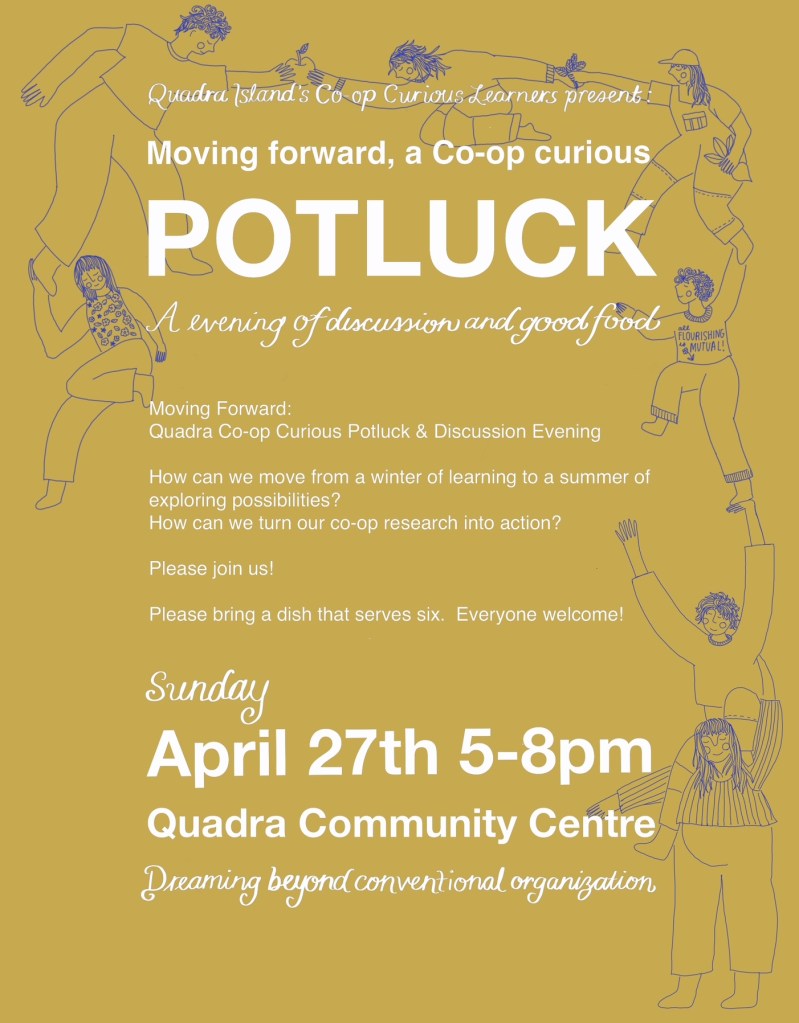
Resolved to explore possibilities of what kind of co-op(s) might work Quadra, we invite the community to join us in our discussion and begin to move research into action. We will be hosting some Potluck & Discussion events during the summer of 2025, beginning with this one:
Moving Forward: Quadra Co-op Curious Potluck & Discussion Evening
Sunday, April 27th, 5-8pm at the Quadra Community Centre
Please bring a dish that serves six. Everyone welcome.
Please join us!
Perhaps you are wondering, what is a cooperative anyways? Here’s some helpful info that we found on the BC Co-op Association website:
What is a cooperative?
According to the BC Co-op Association, a cooperative is “A voluntary association of members coming together to serve a common need.”
A longer, more comprehensive definition is “an autonomous association of persons united voluntarily to meet their common economic, social, and cultural needs and aspirations through a jointly-owned and democratically-controlled enterprise.”
What attracts many people to cooperatives is the values and principles that co-ops are based on.
Values
Co-operatives are based on the values of self-help, self-responsibility, democracy, equality, equity and solidarity. In the tradition of their founders, co-operative members believe in the ethical values of honesty, openness, social responsibility and caring for others.
Principles
The co-operative principles are guidelines by which co-operatives put their values into practice.
1. Voluntary and Open membership
Co-operatives are voluntary organizations, open to all persons able to use their services and willing to accept the responsibilities of membership, without gender, social, racial, political, or religious discrimination.
2. Democratic Member Control
Co-operatives are democratic organizations controlled by their members, who actively participate in setting their policies and making decisions on the principle of one member one vote. Members serving as elected representatives are accountable to the membership.
3. Member Economic Participation
Members contribute to and democratically control the capital of their co-operative. At least part of that capital is usually the common property of the co-operative. The co-operative’s surplus is either distributed to its members in proportion to their transactions with the co-op, or directed to other activities approved by the membership.
4. Autonomy and Independence
Co-operatives are autonomous, self-help organizations controlled by their members. If they enter into agreements with other organizations, including governments, or raise capital from external sources, they do so on terms that ensure democratic control by their members and maintain their co-operative autonomy.
5. Education, Training and Information
Co-operatives provide education and training for their members, elected representatives, managers, and employees so they can contribute effectively to the development of their co-operatives. They also strive to inform the general public – particularly young people and opinion leaders – about the nature and benefits of co-operation.
6. Co-operation among Co-operatives
Co-operatives serve their members and strengthen the co-operative movement by working in solidarity with other co-ops and national, regional, and international co-operative organizations.
7. Concern for Community
Co-operatives work for the sustainable development of their communities through policies approved by their members.
Source: BC Co-op Association https://bcca.coop
 Quadra Co-Op Curious Learners